
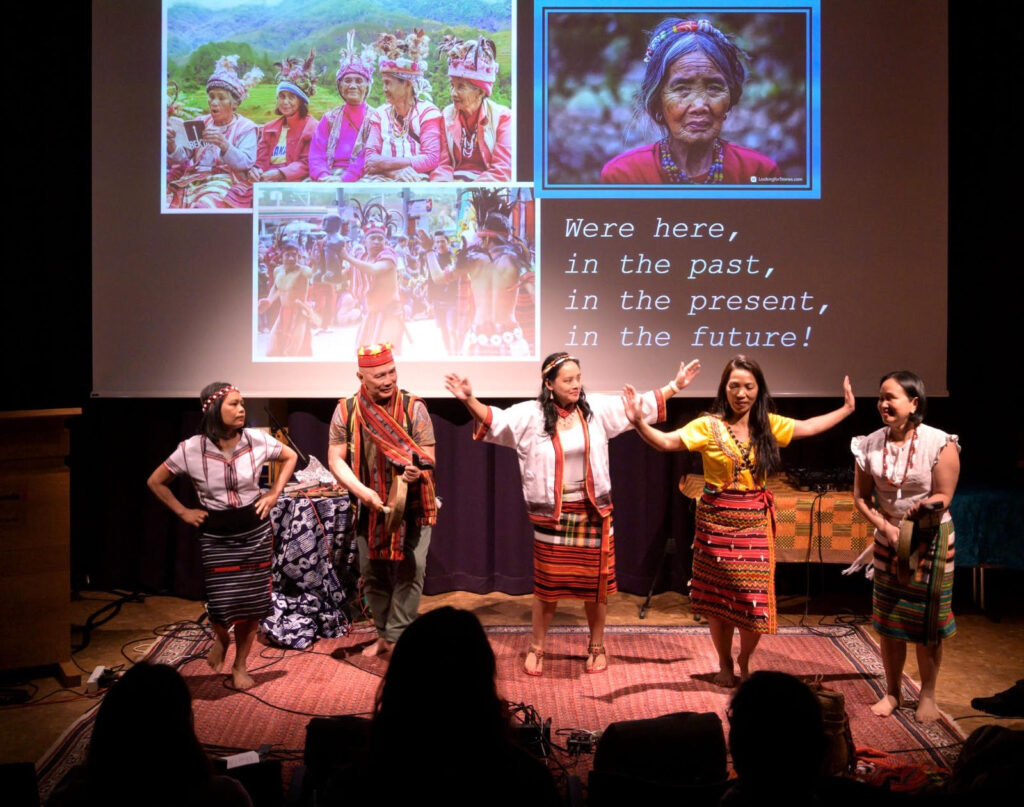
Am Spring Rumble vom 14. März 2026 standen unsere Freund*innen von BIBAK Switzerland auf der Bühne des Völkerkunde?museums der UZH. Folgender Beitrag stammt von Lorena Clerc. (Ihr Text ist zurzeit nur auf Englisch verfügbar.)
When history becomes personal
After a long day at work on 12 February 2026, I stopped by home to briefly to pick up the biko I had prepared for studiyo filipino’s Spring Sala at the Ethnographic Museum of the University of Zurich. At the Sala, Studiyo Filipino introduced the Rumble ‘non-exhibit’ to its greater network, inviting members of the Filipino Community to occupy the space. I arrived tired, intending only to listen. But something tightened in my chest when I heard the word “healing” and the exhibitions of Filipinos in places such as the 1904 St. Louis World’s Fair in Missouri and across Europe. That history is not abstract to me; it lives in my blood. I felt a sudden urge to speak.
With a trembling voice, I shared that I come from an indigenous tribe in Northern Philippines. My ancestors were among those who were taken, displayed, and stared at as curiosities. Each time I hear this part of our history, it hurts not only because of what colonial powers did, but because of how those narratives still linger to the point that even fellow Filipinos learned to see us through the eyes of the colonizers. The effect of this on us as present-day Igorots is that we constantly negotiate how to represent ourselves. We are deeply proud of our culture; we carry it wherever we go. There are Igorot organizations in the United States, in London, and in many other countries, including Switzerland. We gather to dance, to sing, to help each other in times of need, to celebrate, and to pass our traditions forward. Yet this pride is often accompanied by uncertainty. When we are asked to dance or sing cultural Igorot pieces in public, we ask ourselves: are we truly expressing who we are, or are we simply satisfying the curiosity of onlookers—something our ancestors once had to endure?
I didn’t expect my words to hit so hard. The room went quiet. Then Rohit Jain, co-curator of Rumble in the Archive, reached out through Studiyo Filipino. «Come contribute something,» he said. «Art, performance, whatever—reclaim your story.»
Creating a Piece on Our Own Terms
I took his invitation to heart. It felt like a once-in-a-lifetime opportunity for our small Igorot community in Switzerland: a chance to correct the record, to encourage healing, and to imagine reparation in our own voice. I started writing a piece that would later be called Our Bodies Remember: From Display to Dignity.
At first, I worried whether I could gather a group. Our BIBAK (acronym for the Bontoc, Ifugao, Benguet, Apayao, Kalinga tribes) members are scattered across the country. “Do it alone if you have to,” Bea from studiyo filipino said. But three friends: Diana, Rebecca, and Airen signed up. We still needed another gong player, and after some coaxing, Manong Fred agreed to join.
We met online to share the script, traded human zoo articles in our BIBAK chat, and rehearsed in person. The team suggested Uggayam chants between poetry verses and gong beats to go along with the song Dong-dong-ay. Everyone had a role – all of us shining together, Igorot-style.
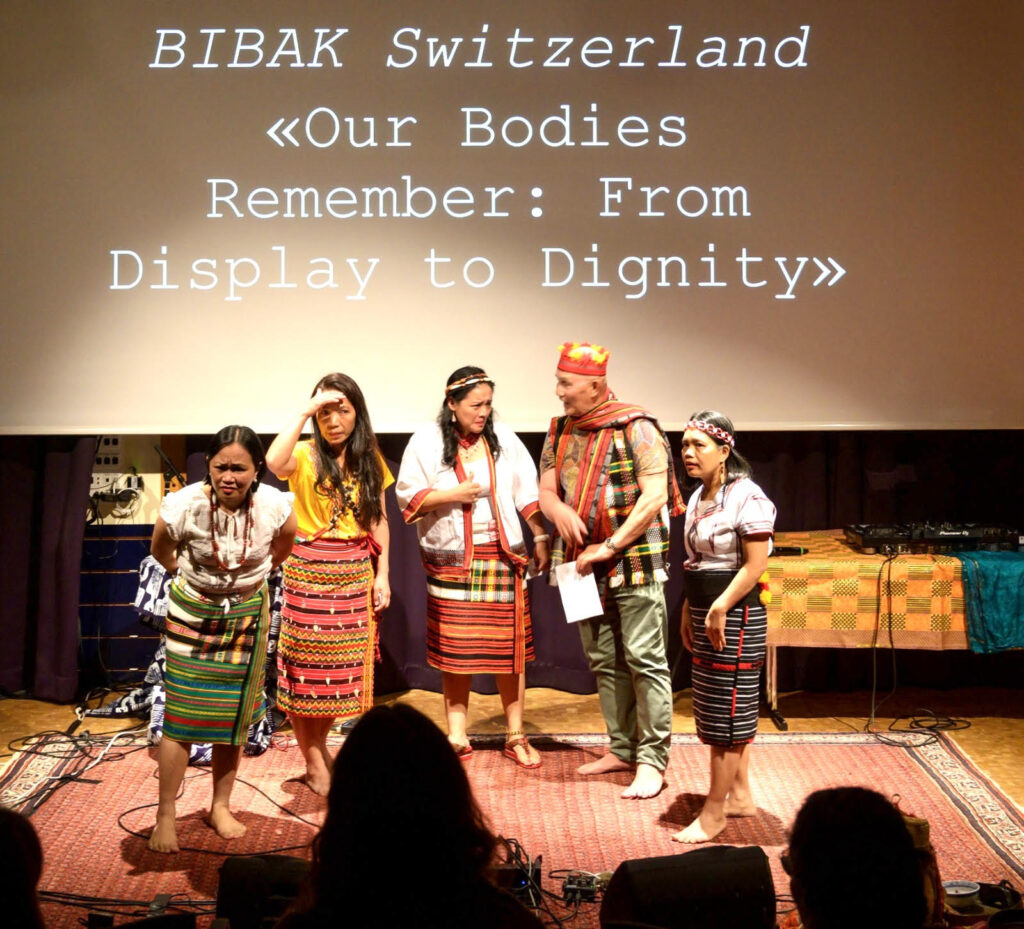
On the day of the Spring Rumble, our performance began in silence. The sound of the gong pierced the room, calling the audience to attention. We entered the stage and stared at the audience in wordless stillness. One full minute. Then another. The silence thickened until the air itself felt heavy. That moment was intentional. We wanted people to feel, even for a minute, what it means to be watched, to be stared at as someone’s curiosity. Finally, Diana broke the silence:
“That is how it feels to be looked at.”
From there, the poem I originally composed for this piece Calling You Home unfolded as an invocation, where Uggayam chants rose between verses:
“The body remembers what fences could not contain…Your names, your quiet refusal to disappear. ”
We were calling our ancestorshome. This part felt sacred, like a memorial and a ritual of reconnection.
After the invocation, fast and urgent gongbeats filled the space. We shifted into confusion. It symbolized what many of us today still feel: pride in our culture, yet unease about how others see it. Then came the turning point – one by one, we introduced ourselves, not as caricatures of “tribal people,” but as living individuals.
“I’m Lorena, I work as a financial accountant in Zürich, helping businesses stay transparent and responsible.”
The others followed calmly. That small act of self-naming carried quiet authority, our way of reclaiming how we wished to be seen. Finally, Airen sang her original version of Dong-dong-ay si Dong-ilay, while I and Manong Fred played the gong softly in the background. The lyrics translated our collective message:
“Our claim is to be recognized as equals in dignity and voice—no longer objects of curiosity, but participants in society whose histories, knowledge, and contributions matter.”
The gongs then filled the air, and we danced, while the audience clapped to the beat.
From Exhibit to Co-authors
Looking back to that evening, we felt fortunate to share the stage with academics, artists, activists and scholars working on post-colonialism. We came from different languages, methods, and life worlds, but reaching for the same truth: to confront power, remember the past, and imagine other futures. It humbled us. It reminded us that we have allies, and that the city we live in is built from many histories, many worlds. To acknowledge this plurality is not a burden. It is beauty, depending on how one looks. For one luminous moment, we, the descendants of those once displayed in human zoos stood not as exhibits, but as storytellers, performers, and co-authors of history.
We are grateful to the museum for opening its doors to living indigenous voices. That night, some truths about us found their names: we are indigenous and at the same time modern, and that is awesome! To keep our culture alive, we must choose our audiences and settings wisely, because like any organism, culture blooms best in a nurturing environment.
BIBAK Performer*innen: Rebecca Bernet, Lorena Clerc, Diana Dänzer, Alfredo Labfayong, Airen Rüttimann
Fotos courtesy of BIBAK/Völkerkunde?museum der UZH (Marc Latzel) 2026
